Energy Drink
Red Bull North America, Inc. · Soda · barcode 00611269623734
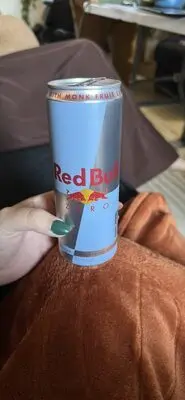
Wrong photo? Fix it on Open Food Facts or email us.
What stands out
Bars show one serving: 12 fl oz, 355 ml, from the label.
- Likely this product
A lab test of a product with this brand and name found DEHP in 1 of 2 samples, highest 14 ppb (matched by name; the lab recorded no barcode). Details
2% of a toddler's daily limitunder 1% of an adult's daily limit - Likely this product
A lab test of a product with this brand and name found DBP (di-n-butyl phthalate) in 1 of 2 samples, highest 17 ppb (matched by name; the lab recorded no barcode). Details
under 1% of a toddler's daily limitunder 1% of an adult's daily limit - Likely this product
A lab test of a product with this brand and name found DEHT (DOTP) in 1 of 2 samples, highest 25.1 ppb (matched by name; the lab recorded no barcode). Details
- Recall
1 FDA recall names this barcode (2015, closed): Red Bull North America is recalling Red Bull Branded Total Zero Energy Drink…. Details
- Lab testsA lab tested a product with this brand and name. See results
- Recalls1 FDA recall names this barcode (2015, closed). Details
- Additives2 ingredients have a label or school-food rule in some states. Which
- TypicalFDA's tests of soda show what's typical. See levels
- Others9 other soda products have lab results. Compare them
Lab results for a matching product
Likely this product: the lab recorded its brand and name but not its barcode, so we matched it by brand and name. Package size and recipe may differ.
Red Bull Energy Drink Original
Measured in this product PlasticList (2024)
- DEHP: found in 1 of 2 samples (highest 14 ppb).
Even at the highest sample, a toddler would need about 21 L (87½ cups) a day to reach EPA's daily limit; an adult more than 100 liters.
One serving (12 fl oz, 355 ml, from the label):2% of a toddler's daily limitunder 1% of an adult's daily limit
- DBP (di-n-butyl phthalate): found in 1 of 2 samples (highest 17 ppb).
Even at the highest sample, a toddler would need about 88 L (366¾ cups) a day to reach EPA's daily limit; an adult more than 100 liters.
One serving (12 fl oz, 355 ml, from the label):under 1% of a toddler's daily limitunder 1% of an adult's daily limit
- DEHT (DOTP): found in 1 of 2 samples (highest 25.1 ppb). No US agency limit we can cite.
- BPF (bisphenol F): 3.65 ppb (found in 2 of 2 samples, highest 3.7).
No US agency limit we can cite.
Among tested products of this kind (ppb, log scale): this one others
Each dot is one product. Hover over or tap a column for its count and, for 5 or fewer products, their names.
Not found above the lab's limit: DEP (diethyl phthalate), DNOP (di-n-octyl phthalate), DCHP (dicyclohexyl phthalate), DNHP (di-n-hexyl phthalate), DIBP (diisobutyl phthalate), BBP (benzyl butyl phthalate), DIDP (diisodecyl phthalate), DMP (dimethyl phthalate), DINP (diisononyl phthalate), DINCH, DIDA (diisodecyl adipate), DEHA, BPA (bisphenol A), BPS (bisphenol S).
FDA recalls
- 2015-12-16 · Class III · Terminated Red Bull North America is recalling Red Bull Branded Total Zero Energy Drink because the cans are missing the statement "Phenylketonurics: Contains Phenylalanine", a mandatory requirement on all products that contain aspartame.Red Bull North America Inc: Red Bull Total Zero Energy Drink, 12 fl.oz. (355ml), UPC CODE(S): ON THE CAN: 6 11269 62373 4; ON THE CASE: 6 11269 61505 0 Recall F-0352-2016 details
Additives with restrictions somewhere
From the ingredient list on file (label data dated 2019-12-06). Recipes change, so check the package you have.
Rules that apply to more than one of these
- US (FDA): Allowed FDA approved it as a sweetener. Source. Applies to all of them.
- EU: Allowed (Regulation (EC) No 1333/2008) Source. Applies to all of them.
- Louisiana: Banned in school meals from 2028-2029 school year Banned in Louisiana school food from the 2028-2029 school year (concession stands and vending machines exempt). (SB 14, Act 463 (2025)) Source. Applies to all of them.
- Louisiana: Warning label required from 2028-01-01 Products containing it must carry a QR code disclosure from January 1, 2028. (SB 14, Act 463 (2025)) Source. Applies to all of them.
Sucralose (E955)
Only the shared rules above.
Acesulfame potassium (E950)
Only the shared rules above.
Typical for soda
FDA's averages for this kind of food (this product has its own lab results above)
What FDA found when it bought and tested this kind of food across the US. These are not tests of this product.
- Lead, Cadmium, Mercury, Arsenic (total): usually below 1 ppb, the lab's limit, in FDA's samples.
FDA samples behind these numbers
- Lead in Carbonated beverage, cola, diet: found in 0 of 3 samples, all below 1 ppb (2018-2020)
- Lead in Carbonated beverage, cola, regular: found in 0 of 3 samples, all below 1 ppb (2018-2020)
- Lead in Carbonated beverage, lemon-lime, regular: found in 0 of 3 samples, all below 1 ppb (2018-2020)
- Cadmium in Carbonated beverage, cola, diet: found in 0 of 3 samples, all below 1 ppb (2018-2020)
- Cadmium in Carbonated beverage, cola, regular: found in 0 of 3 samples, all below 1 ppb (2018-2020)
- Cadmium in Carbonated beverage, lemon-lime, regular: found in 0 of 3 samples, all below 1 ppb (2018-2020)
- Mercury in Carbonated beverage, cola, diet: found in 0 of 3 samples, all below 1 ppb (2018-2020)
- Mercury in Carbonated beverage, cola, regular: found in 0 of 3 samples, all below 1 ppb (2018-2020)
- Mercury in Carbonated beverage, lemon-lime, regular: found in 0 of 3 samples, all below 1 ppb (2018-2020)
- Arsenic (total) in Carbonated beverage, cola, diet: found in 0 of 3 samples, all below 1 ppb (2018-2020)
- Arsenic (total) in Carbonated beverage, cola, regular: found in 0 of 3 samples, all below 1 ppb (2018-2020)
- Arsenic (total) in Carbonated beverage, lemon-lime, regular: found in 0 of 3 samples, all below 1 ppb (2018-2020)
- Perchlorate in Carbonated beverage, cola, low-calorie: found in 6 of 20 samples, average 1.66, highest 26 ppb (2008-2012)
- Perchlorate in Carbonated beverage, cola, regular: found in 3 of 20 samples, average 0.2, highest 2 ppb (2008-2012)
Left out of the summary above: Perchlorate. FDA measured it in only some of these foods, so the result describes those foods, not the whole kind.
"Typically" is FDA's middle sample. Daily amounts use the long-run average and each chemical's daily limit (EPA reference dose, or FDA's level for lead) for a 33-lb toddler and a 154-lb adult. ppb = micrograms per kilogram of food. Source: FDA Total Diet Study.
Not tested
No published results for this product cover: Metals, Perchlorate. That means nobody has published a test, not that these are absent.
Ingredients (from the label)
CARBONATED WATER, TAURINE, CITRIC ACID, NATURAL AND ARTIFICIAL FLAVORS, PHOSPHORIC ACID, SODIUM CITRATE, COLORS, CAFFEINE, SUCRALOSE, XANTHAN GUM, ACESULFAME K, NIACINAMIDE, PYRIDOXINE HCL, CALCIUM PANTOTHENATE, VITAMIN B12.
From USDA FoodData Central, label dated 2019-12-06. Labels change; check the package.