Red Bull Energy Drink, 8.4 Fl Oz, 6 Count
Red Bull North America, Inc. · Other Drinks · barcode 00611269431575
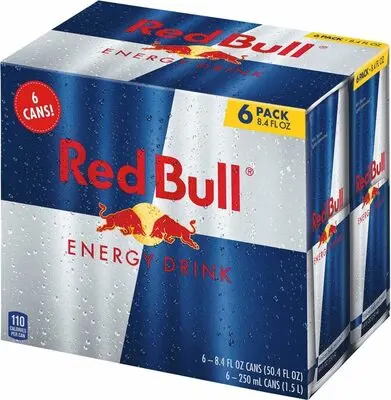
Wrong photo? Fix it on Open Food Facts or email us.
What stands out
Bars show one serving: 250 ml, from the label.
- Likely this product
A lab test of a product with this brand and name found DEHP in 1 of 2 samples, highest 14 ppb (matched by name; the lab recorded no barcode). Details
1% of a toddler's daily limitunder 1% of an adult's daily limit - Likely this product
A lab test of a product with this brand and name found DBP (di-n-butyl phthalate) in 1 of 2 samples, highest 17 ppb (matched by name; the lab recorded no barcode). Details
under 1% of a toddler's daily limitunder 1% of an adult's daily limit - Likely this product
A lab test of a product with this brand and name found DEHT (DOTP) in 1 of 2 samples, highest 25.1 ppb (matched by name; the lab recorded no barcode). Details
- Lab testsA lab tested a product with this brand and name. See results
- RecallsNo FDA recall lists this barcode.
- AdditivesNone of the additives we track appear in the ingredients.
- TypicalFDA's tests of other drinks show what's typical. See levels
Lab results for a matching product
Likely this product: the lab recorded its brand and name but not its barcode, so we matched it by brand and name. Package size and recipe may differ.
Red Bull Energy Drink Original
Measured in this product PlasticList (2024)
- DEHP: found in 1 of 2 samples (highest 14 ppb).
Even at the highest sample, a toddler would need about 21 L (87½ cups) a day to reach EPA's daily limit; an adult more than 100 liters.
One serving (250 ml, from the label):1% of a toddler's daily limitunder 1% of an adult's daily limit
- DBP (di-n-butyl phthalate): found in 1 of 2 samples (highest 17 ppb).
Even at the highest sample, a toddler would need about 88 L (366¾ cups) a day to reach EPA's daily limit; an adult more than 100 liters.
One serving (250 ml, from the label):under 1% of a toddler's daily limitunder 1% of an adult's daily limit
- DEHT (DOTP): found in 1 of 2 samples (highest 25.1 ppb). No US agency limit we can cite.
- BPF (bisphenol F): 3.65 ppb (found in 2 of 2 samples, highest 3.7).
No US agency limit we can cite.
Among tested products of this kind (ppb, log scale): this one others
Each dot is one product. Hover over or tap a column for its count and, for 5 or fewer products, their names.
Not found above the lab's limit: DEP (diethyl phthalate), DNOP (di-n-octyl phthalate), DCHP (dicyclohexyl phthalate), DNHP (di-n-hexyl phthalate), DIBP (diisobutyl phthalate), BBP (benzyl butyl phthalate), DIDP (diisodecyl phthalate), DMP (dimethyl phthalate), DINP (diisononyl phthalate), DINCH, DIDA (diisodecyl adipate), DEHA, BPA (bisphenol A), BPS (bisphenol S).
Typical for other drinks
FDA's averages for this kind of food (this product has its own lab results above)
FDA doesn't test this exact kind of food, so these are the closest foods it does test. Treat them as a rough guide.
- Lead, Cadmium, Mercury, Arsenic (total): usually below 1 ppb, the lab's limit, in FDA's samples.
FDA samples behind these numbers
- Lead in Beverage, energy: found in 0 of 3 samples, all below 1 ppb (2018-2020)
- Lead in Beverage, sports: found in 0 of 3 samples, all below 1 ppb (2018-2020)
- Lead in Fruit drink (5% - 25% juice), canned or bottled: found in 0 of 3 samples, all below 1 ppb (2018-2020)
- Lead in Fruit drink, from powder: found in 0 of 3 samples, all below 1 ppb (2018-2020)
- Cadmium in Beverage, energy: found in 0 of 3 samples, all below 1 ppb (2018-2020)
- Cadmium in Beverage, sports: found in 0 of 3 samples, all below 1 ppb (2018-2020)
- Cadmium in Fruit drink (5% - 25% juice), canned or bottled: found in 0 of 3 samples, all below 1 ppb (2018-2020)
- Cadmium in Fruit drink, from powder: found in 0 of 3 samples, all below 1 ppb (2018-2020)
- Mercury in Beverage, energy: found in 0 of 3 samples, all below 1 ppb (2018-2020)
- Mercury in Beverage, sports: found in 0 of 3 samples, all below 1 ppb (2018-2020)
- Mercury in Fruit drink (5% - 25% juice), canned or bottled: found in 0 of 3 samples, all below 1 ppb (2018-2020)
- Mercury in Fruit drink, from powder: found in 0 of 3 samples, all below 1 ppb (2018-2020)
- Arsenic (total) in Beverage, energy: found in 0 of 3 samples, all below 1 ppb (2018-2020)
- Arsenic (total) in Beverage, sports: found in 0 of 3 samples, all below 1 ppb (2018-2020)
- Arsenic (total) in Fruit drink (5% - 25% juice), canned or bottled: found in 1 of 3 samples, average 0.37, highest 1.1 ppb (2018-2020)
- Arsenic (total) in Fruit drink, from powder: found in 0 of 3 samples, all below 1 ppb (2018-2020)
- Perchlorate in Fruit drink (10% juice), canned or bottled: found in 4 of 20 samples, average 0.2, highest 1 ppb (2008-2012)
- Perchlorate in Fruit drink, from powder: found in 5 of 20 samples, average 0.33, highest 2 ppb (2008-2012)
Left out of the summary above: Perchlorate. FDA measured it in only some of these foods, so the result describes those foods, not the whole kind.
"Typically" is FDA's middle sample. Daily amounts use the long-run average and each chemical's daily limit (EPA reference dose, or FDA's level for lead) for a 33-lb toddler and a 154-lb adult. ppb = micrograms per kilogram of food. Source: FDA Total Diet Study.
Not tested
No published results for this product cover: Metals, Perchlorate. That means nobody has published a test, not that these are absent.
Ingredients (from the label)
CARBONATED WATER, SUCROSE, GLUCOSE, CITRIC ACID, TAURINE, SODIUM BICARBONATE, MAGNESIUM CARBONATE, CAFFEINE, NIACINAMIDE, CALCIUM PANTOTHENATE, PYRIDOXINE HCL, VITAMIN B12, NATURAL AND ARTIFICIAL FLAVORS, COLORS
From USDA FoodData Central, label dated 2023-06-29. Labels change; check the package.