Good & Gather Quinoa
Target Stores · Other Grains & Seeds · barcode 00085239052914
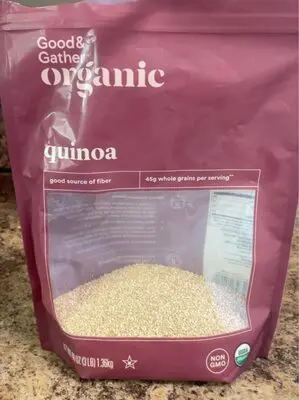
Wrong photo? Fix it on Open Food Facts or email us.
What stands out
Bars show one serving: 45 g, from the label.
- Likely this product
A lab test of a product with this brand and name found lead: 4.3 ppb in 1 sample (matched by name; the lab recorded no barcode). Details
9% of a toddler's daily limit2% of an adult's daily limit - Likely this product
A lab test of a product with this brand and name found cadmium: 27.3 ppb in 1 sample (matched by name; the lab recorded no barcode). Details
8% of a toddler's daily limit2% of an adult's daily limit - Likely this product
A lab test of a product with this brand and name found arsenic (total): 14.7 ppb in 1 sample (matched by name; the lab recorded no barcode). Details
- Lab testsA lab tested a product with this brand and name. See results
- RecallsNo FDA recall lists this barcode.
- AdditivesNone of the additives we track appear in the ingredients.
- TypicalFDA's tests of other grains & seeds show what's typical. See levels
Lab results for a matching product
Likely this product: the lab recorded its brand and name but not its barcode, so we matched it by brand and name. Package size and recipe may differ.
Good & Gather Organic Quinoa
Measured in this product Healthy Babies Bright Futures (2025), via detectlead.com (2025)
- Lead: 4.3 ppb (found in 1 of 1 sample, highest 4.3).
A toddler reaches FDA's daily limit at about 510 g (18 oz) a day of this; an adult at about 2 kg (4.4 lb).
One serving (45 g, from the label):9% of a toddler's daily limit2% of an adult's daily limitAmong tested products of this kind (ppb, log scale): this one others
Each dot is one product. Hover over or tap a column for its count and, for 5 or fewer products, their names.
- Arsenic (total): 14.7 ppb (found in 1 of 1 sample, highest 14.7).
No US agency limit we can cite.
Among tested products of this kind (ppb, log scale): this one others
Each dot is one product. Hover over or tap a column for its count and, for 5 or fewer products, their names.
- Cadmium: 27.3 ppb (found in 1 of 1 sample, highest 27.3).
A toddler reaches EPA's daily limit at about 550 g (19 oz) a day of this; an adult at about 2.6 kg (5.7 lb).
One serving (45 g, from the label):8% of a toddler's daily limit2% of an adult's daily limitAmong tested products of this kind (ppb, log scale): this one others
Each dot is one product. Hover over or tap a column for its count and, for 5 or fewer products, their names.
Typical for other grains & seeds
FDA's averages for this kind of food (this product has its own lab results above)
FDA doesn't test this exact kind of food, so these are the closest foods it does test. Treat them as a rough guide.
- Cadmium: typically 34.3 ppb (FDA, 33 samples, 2017-2020). A toddler reaches EPA's daily limit at about 400 g (14 oz) a day; an adult at about 1.9 kg (4.2 lb).
- Arsenic (total): typically 52.4 ppb (FDA, 33 samples, 2017-2020). No US agency limit we can cite.
- Lead, Mercury: usually below 4 ppb, the lab's limit, in FDA's samples.
FDA samples behind these numbers
- Lead in Quinoa, cooked: found in 1 of 3 samples, average 3.67, highest 11 ppb (2018-2020)
- Lead in Rice, brown, cooked: found in 0 of 27 samples, all below 4 ppb (2017-2020)
- Lead in Seeds, sunflower, shelled, salted, roasted: found in 0 of 3 samples, all below 5 ppb (2018-2020)
- Cadmium in Quinoa, cooked: found in 3 of 3 samples, average 11.2, highest 19 ppb (2018-2020)
- Cadmium in Rice, brown, cooked: found in 27 of 27 samples, average 7.98, highest 17 ppb (2017-2020)
- Cadmium in Seeds, sunflower, shelled, salted, roasted: found in 3 of 3 samples, average 333, highest 400 ppb (2018-2020)
- Mercury in Quinoa, cooked: found in 0 of 3 samples, all below 1 ppb (2018-2020)
- Mercury in Rice, brown, cooked: found in 8 of 27 samples, average 0.36, highest 1.5 ppb (2017-2020)
- Mercury in Seeds, sunflower, shelled, salted, roasted: found in 1 of 3 samples, average 0.43, highest 1.3 ppb (2018-2020)
- Arsenic (total) in Quinoa, cooked: found in 1 of 3 samples, average 3.33, highest 10 ppb (2018-2020)
- Arsenic (total) in Rice, brown, cooked: found in 27 of 27 samples, average 64.3, highest 88 ppb (2017-2020)
- Arsenic (total) in Seeds, sunflower, shelled, salted, roasted: found in 1 of 3 samples, average 2.17, highest 6.5 ppb (2018-2020)
- Perchlorate in Sunflower seeds (shelled), roasted, salted: found in 7 of 20 samples, average 0.56, highest 4 ppb (2008-2012)
Left out of the summary above: Perchlorate. FDA measured it in only some of these foods, so the result describes those foods, not the whole kind.
"Typically" is FDA's middle sample. Daily amounts use the long-run average and each chemical's daily limit (EPA reference dose, or FDA's level for lead) for a 33-lb toddler and a 154-lb adult. ppb = micrograms per kilogram of food. Source: FDA Total Diet Study.
Not tested
No published results for this product cover: Perchlorate, Phthalates (plastic softeners), Phthalate substitutes, Bisphenols. That means nobody has published a test, not that these are absent.
Ingredients (from the label)
ORGANIC WHITE QUINOA.
From USDA FoodData Central, label dated 2023-07-13. Labels change; check the package.