Vigo Saffron Yellow Rice
Vigo Importing Company · Rice · barcode 00071072013014
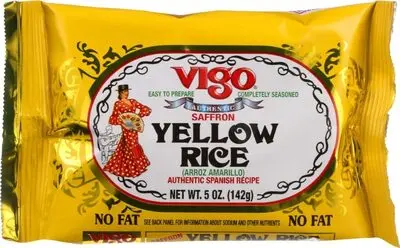
Wrong photo? Fix it on Open Food Facts or email us.
What stands out
Bars show one serving: 1/3 cup, 56 g, from the label.
- Likely this product
A lab test of a product with this brand and name found cadmium: middle result 50.5 ppb across 3 samples, highest 50.7 ppb (matched by name; the lab recorded no barcode). Details
19% of a toddler's daily limit4% of an adult's daily limit - Likely this product
A lab test of a product with this brand and name found lead: middle result 5.5 ppb across 3 samples, highest 6.5 ppb (matched by name; the lab recorded no barcode). Details
14% of a toddler's daily limit4% of an adult's daily limit - Likely this product
A lab test of a product with this brand and name found mercury: middle result 1.55 ppb across 2 samples, highest 1.9 ppb (matched by name; the lab recorded no barcode). Details
6% of a toddler's daily limit1% of an adult's daily limit - Typical for this kind of food
FDA found about 42 ppb inorganic arsenic in white rice like this (not a test of this product). Details
- From the label
The ingredients list Yellow No. 5 (tartrazine) and Red No. 3 (erythrosine), which have stricter rules elsewhere. Strictest: US (FDA) ban from 2027; EU warning label. Details
- Lab testsA lab tested a product with this brand and name. See results
- RecallsNo FDA recall lists this barcode.
- Additives2 ingredients have stricter rules elsewhere. Strictest: US (FDA) ban from 2027; EU warning label. Which
- TypicalFDA's tests of rice show what's typical. See levels
- Others122 other rice products have lab results. Compare them
Lab results for a matching product
Likely this product: the lab recorded its brand and name but not its barcode, so we matched it by brand and name. Package size and recipe may differ.
Vigo Saffron Yellow Rice - Arroz Amarillo
Measured in this product Healthy Babies Bright Futures (2025), via detectlead.com (2025)
- Lead: 5.5 ppb (found in 3 of 3 samples, highest 6.5).
A toddler reaches FDA's daily limit at about 400 g (14 oz) a day of this; an adult at about 1.6 kg (3.5 lb).
One serving (1/3 cup, 56 g, from the label):14% of a toddler's daily limit4% of an adult's daily limitAmong tested products of this kind (ppb, log scale): this one others
Each dot is one product. Hover over or tap a column for its count and, for 5 or fewer products, their names.
- Arsenic (total): 129 ppb (found in 3 of 3 samples, highest 181).
No US agency limit we can cite.
Among tested products of this kind (ppb, log scale): this one others
Each dot stands for up to 2 products. Hover over or tap a column for its count.
- Cadmium: 50.5 ppb (found in 3 of 3 samples, highest 50.7).
A toddler reaches EPA's daily limit at about 300 g (11 oz) a day of this; an adult at about 1.4 kg (3.1 lb).
One serving (1/3 cup, 56 g, from the label):19% of a toddler's daily limit4% of an adult's daily limitAmong tested products of this kind (ppb, log scale): this one others
Each dot stands for up to 2 products. Hover over or tap a column for its count.
- Mercury: 1.55 ppb (found in 2 of 2 samples, highest 1.9).
A toddler reaches EPA's daily limit at about 970 g (34 oz) a day of this; an adult at about 4.5 kg (9.9 lb).
One serving (1/3 cup, 56 g, from the label):6% of a toddler's daily limit1% of an adult's daily limitAmong tested products of this kind (ppb, log scale): this one others
Each dot is one product. Hover over or tap a column for its count and, for 5 or fewer products, their names.
Additives with restrictions somewhere
From the ingredient list on file (label data dated 2022-12-22). Recipes change, so check the package you have.
Rules that apply to more than one of these
- West Virginia: Banned from 2028-01-01 Food containing it is treated as adulterated in West Virginia from January 1, 2028. (HB 2354 (2025)) Source. Applies to all of them.
- West Virginia: Banned in school meals from 2025-08-01 Banned in West Virginia school meals since August 1, 2025. (HB 2354 (2025)) Source. Applies to all of them.
- Texas: Warning label required from 2027-01-01 Labels developed on or after January 1, 2027 must warn that the product contains an ingredient not recommended for consumption in Australia, Canada, the EU or the UK. (SB 25 (2025)) Source. Applies to all of them.
- Louisiana: Banned in school meals from 2028-2029 school year Banned in Louisiana school food from the 2028-2029 school year (concession stands and vending machines exempt). (SB 14, Act 463 (2025)) Source. Applies to all of them.
- Louisiana: Warning label required from 2028-01-01 Products containing it must carry a QR code disclosure from January 1, 2028. (SB 14, Act 463 (2025)) Source. Applies to all of them.
Yellow No. 5 (tartrazine) (E102)
- US (FDA): Allowed FDA allows Yellow No. 5 as a certified color additive. Source
- EU: Allowed with warning label Allowed as E102, but foods containing it must say it "may have an adverse effect on activity and attention in children." (Regulation (EC) No 1333/2008, Annex V) Source
- California: Banned in school meals from 2027-12-31 Banned in food and drinks offered in California public schools from December 31, 2027. (AB 2316 (2024)) Source
Red No. 3 (erythrosine) (E127)
- US (FDA): Authorization revoked from 2027-01-15 FDA revoked its approval for food; food makers must stop using it by January 15, 2027 (ingested drugs by January 18, 2028). (90 FR 4628 (2025)) Source
- EU: Allowed On the EU's list of approved additives as E127. Only in cocktail and candied cherries and bigarreaux cherries. (Regulation (EC) No 1333/2008) Source
- California: Banned from 2027-01-01 Banned in food made, sold or distributed in California after January 1, 2027. (AB 418 (2023)) Source
Typical for rice
FDA's averages for this kind of food (this product has its own lab results above)
Compared with FDA's white rice, cooked: what FDA found when it bought and tested it across the US. These are not tests of this product.
- Cadmium: typically 5.2 ppb (FDA, 27 samples, 2017-2020). A toddler reaches EPA's daily limit at about 2.3 kg (5.1 lb) a day; an adult at about 11 kg (24 lb).
- Arsenic (total): typically 43 ppb (FDA, 27 samples, 2017-2020). No US agency limit we can cite.
- Inorganic arsenic: typically 41.6 ppb (FDA, 1 samples, 2019). A toddler reaches EPA's daily limit at about 22 g (0.78 oz) a day; an adult at about 100 g (3.5 oz).
- Lead, Mercury, Perchlorate: usually below 4 ppb, the lab's limit, in FDA's samples.
Total arsenic counts every form of arsenic, including less harmful ones; inorganic arsenic is the more harmful part of it, so its number is part of the total.
FDA samples behind these numbers
- Lead in Rice, white, enriched, cooked: found in 0 of 27 samples, all below 4 ppb (2017-2020)
- Cadmium in Rice, white, enriched, cooked: found in 27 of 27 samples, average 6.54, highest 23 ppb (2017-2020)
- Mercury in Rice, white, enriched, cooked: found in 1 of 27 samples, average 0.05, highest 1.4 ppb (2017-2020)
- Arsenic (total) in Rice, white, enriched, cooked: found in 27 of 27 samples, average 44.8, highest 75 ppb (2017-2020)
- Inorganic arsenic in Rice, white, enriched, cooked: found in 1 of 1 sample, average 41.6, highest 41.6 ppb (2019)
- Perchlorate in Rice, white, enriched, cooked: found in 3 of 20 samples, average 0.55, highest 6 ppb (2008-2012)
"Typically" is FDA's middle sample. Daily amounts use the long-run average and each chemical's daily limit (EPA reference dose, or FDA's level for lead) for a 33-lb toddler and a 154-lb adult. ppb = micrograms per kilogram of food. Source: FDA Total Diet Study.
Not tested
No published results for this product cover: Perchlorate, Phthalates (plastic softeners), Phthalate substitutes, Bisphenols. That means nobody has published a test, not that these are absent.
Ingredients (from the label)
ENRICHED RICE (NIACIN, IRON (FERRIC ORTHOPHOSPHATE), THIAMIN MONONITRATE, FOLIC ACID), DEHYDRATED VEGETABLES (ONION, RED & GREEN BELL PEPPERS, TOMATO), SALT. CONTAINS 2% OR LESS OF: GARLIC, CORN MEAL, SUGAR, MALTODEXTRIN (FROM CORN), HYDROLYZED CORN PROTEIN, MONOSODIUM GLUTAMATE, DEHYDRATED CHICKEN, SPICES, SAFFRON, SODIUM ALUMINOSILICATE (ANTI-CAKING AGENT), ARTIFICIAL COLOR (INCLUDING F.D.&C. YELLOW NO.5, F.D.&C. RED NO.3), CELERY EXTRACT.
From USDA FoodData Central, label dated 2022-12-22. Labels change; check the package.