Pediasure Chocolate Shake, Chocolate
Abbott Laboratories Inc · Children's Nutritional Supplements · barcode 00070074580593
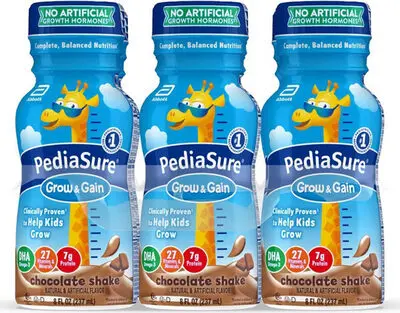
Wrong photo? Fix it on Open Food Facts or email us.
What stands out
Bars show one serving: 1 bottle, 237 ml, from the label.
- Likely this product
A lab test of a product with this brand and name found lead: 1.3 ppb in 1 sample (matched by name; the lab recorded no barcode). Details
14% of a toddler's daily limit4% of an adult's daily limit - Likely this product
A lab test of a product with this brand and name found cadmium: 2 ppb in 1 sample (matched by name; the lab recorded no barcode). Details
3% of a toddler's daily limitunder 1% of an adult's daily limit - Likely this product
A lab test of a product with this brand and name found arsenic (total): 3 ppb in 1 sample (matched by name; the lab recorded no barcode). Details
- From the label
The ingredients list Red No. 3 (erythrosine), which has stricter rules elsewhere. Strictest: US (FDA) ban from 2027. Details
- Lab testsA lab tested a product with this brand and name. See results
- RecallsNo FDA recall lists this barcode.
- Additives1 ingredient has stricter rules elsewhere. Strictest: US (FDA) ban from 2027. Which
- TypicalFDA has no comparable food in its tests.
Lab results for a matching product
Likely this product: the lab recorded its brand and name but not its barcode, so we matched it by brand and name. Package size and recipe may differ.
Pediasure Grow & Gain Chocolate Shake
Measured in this product Healthy Babies Bright Futures (2019), via detectlead.com (2019)
- Lead: 1.3 ppb (found in 1 of 1 sample, highest 1.3).
A toddler reaches FDA's daily limit at about 1.7 L (7 cups) a day of this; an adult at about 6.8 L (28¼ cups).
One serving (1 bottle, 237 ml, from the label):14% of a toddler's daily limit4% of an adult's daily limit
FDA action level for lead in baby food: 10 ppb for packaged baby foods for children under 2: fruits, vegetables (except carrots or sweet potatoes on their own), mixtures, yogurts, custards and single-ingredient meats. SourceAmong tested products of this kind (ppb, log scale): this one othersEach dot stands for up to 14 products. Hover over or tap a column for its count.
- Arsenic (total): 3 ppb (found in 1 of 1 sample, highest 3).
No US agency limit we can cite.
Among tested products of this kind (ppb, log scale): this one others
Each dot stands for up to 16 products. Hover over or tap a column for its count.
- Cadmium: 2 ppb (found in 1 of 1 sample, highest 2).
A toddler reaches EPA's daily limit at about 7.5 L (31¼ cups) a day of this; an adult at about 35 L (145¾ cups).
One serving (1 bottle, 237 ml, from the label):3% of a toddler's daily limitunder 1% of an adult's daily limitAmong tested products of this kind (ppb, log scale): this one others
Each dot stands for up to 11 products. Hover over or tap a column for its count.
Additives with restrictions somewhere
From the ingredient list on file (label data dated 2021-03-19). Recipes change, so check the package you have.
Red No. 3 (erythrosine) (E127)
- US (FDA): Authorization revoked from 2027-01-15 FDA revoked its approval for food; food makers must stop using it by January 15, 2027 (ingested drugs by January 18, 2028). (90 FR 4628 (2025)) Source
- EU: Allowed On the EU's list of approved additives as E127. Only in cocktail and candied cherries and bigarreaux cherries. (Regulation (EC) No 1333/2008) Source
- California: Banned from 2027-01-01 Banned in food made, sold or distributed in California after January 1, 2027. (AB 418 (2023)) Source
- West Virginia: Banned from 2028-01-01 Food containing it is treated as adulterated in West Virginia from January 1, 2028. (HB 2354 (2025)) Source
- West Virginia: Banned in school meals from 2025-08-01 Banned in West Virginia school meals since August 1, 2025. (HB 2354 (2025)) Source
- Texas: Warning label required from 2027-01-01 Labels developed on or after January 1, 2027 must warn that the product contains an ingredient not recommended for consumption in Australia, Canada, the EU or the UK. (SB 25 (2025)) Source
- Louisiana: Banned in school meals from 2028-2029 school year Banned in Louisiana school food from the 2028-2029 school year (concession stands and vending machines exempt). (SB 14, Act 463 (2025)) Source
- Louisiana: Warning label required from 2028-01-01 Products containing it must carry a QR code disclosure from January 1, 2028. (SB 14, Act 463 (2025)) Source
Typical for children's nutritional supplements
FDA's Total Diet Study has no food close enough to this one to give a fair typical level.
Not tested
No published results for this product cover: Perchlorate, Phthalates (plastic softeners), Phthalate substitutes, Bisphenols. That means nobody has published a test, not that these are absent.
Ingredients (from the label)
WATER, CORN MALTODEXTRIN, SUGAR, BLEND OF VEGETABLE OILS (CANOLA, CORN), MILK PROTEIN CONCENTRATE, SOY PROTEIN ISOLATE, COCOA POWDER (PROCESSED WITH ALKALI), NONFAT MILK; LESS THAN 0.5% OF: VITAMINS AND MINERALS, CELLULOSE GEL, NATURAL AND ARTIFICIAL FLAVOR, TUNA OIL, CELLULOSE GUM, SOY LECITHIN, MONOGLYCERIDES, SALT, CARRAGEENAN, POTASSIUM HYDROXIDE, INOSITOL, TURMERIC COLOR, STEVIA LEAF EXTRACT, TAURINE, MONK FRUIT EXTRACT, L-CARNITINE, RED 3, AND LUTEIN. VITAMINS AND MINERALS: CALCIUM PHOSPHATE, POTASSIUM CHLORIDE, POTASSIUM CITRATE, POTASSIUM PHOSPHATE, CALCIUM CARBONATE, MAGNESIUM PHOSPHATE, ASCORBIC ACID, CHOLINE CHLORIDE, FERROUS SULFATE, DL-ALPHA-TOCOPHERYL ACETATE, ZINC SULFATE, NIACINAMIDE, CALCIUM PANTOTHENATE, MANGANESE SULFATE, THIAMINE HYDROCHLORIDE, PYRIDOXINE HYDROCHLORIDE, RIBOFLAVIN, VITAMIN A PALMITATE, COPPER SULFATE, FOLIC ACID, CHROMIUM CHLORIDE, SODIUM MOLYBDATE, SODIUM SELENATE, BIOTIN, PHYLLOQUINONE, POTASSIUM IODIDE, VITAMIN D3, AND VITAMIN B12.
From USDA FoodData Central, label dated 2021-03-19. Labels change; check the package.