Wendy's Frosty Chocolatey Cereal, Chocolate
The Kellogg Company · Cereal · barcode 00038000263231
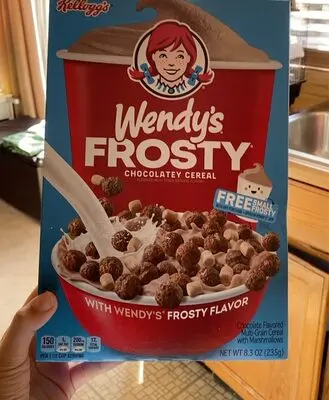
Wrong photo? Fix it on Open Food Facts or email us.
What stands out
Bars show one serving: 42 g, from the label.
- Likely this product
A lab test of a product with this brand and name found DEHP in 1 of 3 samples, highest 11 ppb (matched by name; the lab recorded no barcode). Details
under 1% of a toddler's daily limitunder 1% of an adult's daily limit - Likely this product
A lab test of a product with this brand and name found DEHT (DOTP): middle result 84 ppb across 3 samples, highest 140 ppb (matched by name; the lab recorded no barcode). Details
- From the label
The ingredients list Red No. 40 (Allura Red), Yellow No. 5 (tartrazine), Blue No. 1 (Brilliant Blue) and Yellow No. 6 (Sunset Yellow), which have stricter rules elsewhere. Strictest: West Virginia ban from 2028; EU warning label. Details
- Lab testsA lab tested a product with this brand and name. See results
- RecallsNo FDA recall lists this barcode.
- Additives4 ingredients have stricter rules elsewhere. Strictest: West Virginia ban from 2028; EU warning label. Which
- TypicalFDA's tests of cereal show what's typical. See levels
- Others2 other cereal products have lab results. Compare them
Lab results for a matching product
Likely this product: the lab recorded its brand and name but not its barcode, so we matched it by brand and name. Package size and recipe may differ.
Wendy's Chocolate Frosty
Measured in this product PlasticList (2024-07-21)
- DEHP: found in 1 of 3 samples (highest 11 ppb).
Even at the highest sample, a toddler would need about 27 kg (60 lb) a day to reach EPA's daily limit; an adult more than 100 kg.
One serving (42 g, from the label):under 1% of a toddler's daily limitunder 1% of an adult's daily limit
- DEHT (DOTP): 84 ppb (found in 3 of 3 samples, highest 140).
No US agency limit we can cite.
Among tested products of this kind (ppb, log scale): this one others
Each dot is one product. Hover over or tap a column for its count and, for 5 or fewer products, their names.
Not found above the lab's limit: DMP (dimethyl phthalate), DINP (diisononyl phthalate), DNHP (di-n-hexyl phthalate), DBP (di-n-butyl phthalate), DIBP (diisobutyl phthalate), DEP (diethyl phthalate), DNOP (di-n-octyl phthalate), BBP (benzyl butyl phthalate), DIDP (diisodecyl phthalate), DCHP (dicyclohexyl phthalate), DEHA, DIDA (diisodecyl adipate), DINCH, BPA (bisphenol A), BPS (bisphenol S), BPF (bisphenol F).
Additives with restrictions somewhere
From the ingredient list on file (label data dated 2023-07-13). Recipes change, so check the package you have.
Rules that apply to more than one of these
- US (FDA): Allowed Source. Applies to Red No. 40 (Allura Red), Yellow No. 5 (tartrazine), Blue No. 1 (Brilliant Blue), Yellow No. 6 (Sunset Yellow).
- EU: Allowed with warning label (Regulation (EC) No 1333/2008, Annex V) Source. Applies to Red No. 40 (Allura Red), Yellow No. 5 (tartrazine), Yellow No. 6 (Sunset Yellow).
- California: Banned in school meals from 2027-12-31 Banned in food and drinks offered in California public schools from December 31, 2027. (AB 2316 (2024)) Source. Applies to Red No. 40 (Allura Red), Yellow No. 5 (tartrazine), Blue No. 1 (Brilliant Blue), Yellow No. 6 (Sunset Yellow).
- West Virginia: Banned from 2028-01-01 Food containing it is treated as adulterated in West Virginia from January 1, 2028. (HB 2354 (2025)) Source. Applies to Red No. 40 (Allura Red), Yellow No. 5 (tartrazine), Blue No. 1 (Brilliant Blue), Yellow No. 6 (Sunset Yellow).
- West Virginia: Banned in school meals from 2025-08-01 Banned in West Virginia school meals since August 1, 2025. (HB 2354 (2025)) Source. Applies to Red No. 40 (Allura Red), Yellow No. 5 (tartrazine), Blue No. 1 (Brilliant Blue), Yellow No. 6 (Sunset Yellow).
- Texas: Warning label required from 2027-01-01 Labels developed on or after January 1, 2027 must warn that the product contains an ingredient not recommended for consumption in Australia, Canada, the EU or the UK. (SB 25 (2025)) Source. Applies to all of them.
- Louisiana: Banned in school meals from 2028-2029 school year Banned in Louisiana school food from the 2028-2029 school year (concession stands and vending machines exempt). (SB 14, Act 463 (2025)) Source. Applies to all of them.
- Louisiana: Warning label required from 2028-01-01 Products containing it must carry a QR code disclosure from January 1, 2028. (SB 14, Act 463 (2025)) Source. Applies to all of them.
- EU: Allowed (Regulation (EC) No 1333/2008) Source. Applies to Blue No. 1 (Brilliant Blue), BHT (butylated hydroxytoluene).
Red No. 40 (Allura Red) (E129)
Only the shared rules above.
Yellow No. 5 (tartrazine) (E102)
Only the shared rules above.
Blue No. 1 (Brilliant Blue) (E133)
Only the shared rules above.
Yellow No. 6 (Sunset Yellow) (E110)
Only the shared rules above.
BHT (butylated hydroxytoluene) (E321)
- US (FDA): Allowed FDA allows it as a preservative. Source
Typical for cereal
FDA's averages for this kind of food (this product has its own lab results above)
What FDA found when it bought and tested this kind of food across the US. These are not tests of this product.
- Cadmium: typically 17.3 ppb (FDA, 12 samples, 2018-2020). A toddler reaches EPA's daily limit at about 720 g (25 oz) a day; an adult at about 3.4 kg (7.5 lb).
- Arsenic (total): typically 49.5 ppb (FDA, 12 samples, 2018-2020). No US agency limit we can cite.
- Lead, Mercury: usually below 4 ppb, the lab's limit, in FDA's samples.
FDA samples behind these numbers
- Lead in Cereal, corn flakes: found in 1 of 3 samples, average 1.47, highest 4.4 ppb (2018-2020)
- Lead in Cereal, crisped rice: found in 1 of 3 samples, average 1.5, highest 4.5 ppb (2018-2020)
- Lead in Cereal, oat ring: found in 2 of 3 samples, average 3.6, highest 6.4 ppb (2018-2020)
- Lead in Cereal, shredded wheat, frosted: found in 0 of 3 samples, all below 4 ppb (2018-2020)
- Cadmium in Cereal, corn flakes: found in 3 of 3 samples, average 1.27, highest 1.3 ppb (2018-2020)
- Cadmium in Cereal, crisped rice: found in 3 of 3 samples, average 21.7, highest 39 ppb (2018-2020)
- Cadmium in Cereal, oat ring: found in 3 of 3 samples, average 20, highest 25 ppb (2018-2020)
- Cadmium in Cereal, shredded wheat, frosted: found in 3 of 3 samples, average 39.7, highest 57 ppb (2018-2020)
- Mercury in Cereal, corn flakes: found in 0 of 3 samples, all below 1 ppb (2018-2020)
- Mercury in Cereal, crisped rice: found in 2 of 3 samples, average 2.37, highest 4.1 ppb (2018-2020)
- Mercury in Cereal, oat ring: found in 0 of 3 samples, all below 1 ppb (2018-2020)
- Mercury in Cereal, shredded wheat, frosted: found in 0 of 3 samples, all below 1 ppb (2018-2020)
- Arsenic (total) in Cereal, corn flakes: found in 0 of 3 samples, all below 3 ppb (2018-2020)
- Arsenic (total) in Cereal, crisped rice: found in 3 of 3 samples, average 170, highest 210 ppb (2018-2020)
- Arsenic (total) in Cereal, oat ring: found in 3 of 3 samples, average 29, highest 35 ppb (2018-2020)
- Arsenic (total) in Cereal, shredded wheat, frosted: found in 1 of 3 samples, average 1.1, highest 3.3 ppb (2018-2020)
- Inorganic arsenic in Cereal, crisped rice: found in 3 of 3 samples, average 93.1, highest 103 ppb (2018-2020)
- Perchlorate in Corn flakes cereal: found in 3 of 20 samples, average 0.2, highest 2 ppb (2008-2012)
- Perchlorate in Crisped rice cereal: found in 4 of 20 samples, average 0.45, highest 3 ppb (2008-2012)
- Perchlorate in Oat ring cereal: found in 20 of 20 samples, average 4.9, highest 9 ppb (2008-2012)
Left out of the summary above: Inorganic arsenic, Perchlorate. FDA measured them in only some of these foods, so the result describes those foods, not the whole kind.
"Typically" is FDA's middle sample. Daily amounts use the long-run average and each chemical's daily limit (EPA reference dose, or FDA's level for lead) for a 33-lb toddler and a 154-lb adult. ppb = micrograms per kilogram of food. Source: FDA Total Diet Study.
Not tested
No published results for this product cover: Metals, Perchlorate. That means nobody has published a test, not that these are absent.
Ingredients (from the label)
CORN FLOUR BLEND (WHOLE GRAIN YELLOW CORN FLOUR, DEGERMINATED YELLOW CORN FLOUR), SUGAR, MARSHMALLOWS (SUGAR, DEXTROSE, CORN SYRUP, COCOA, GELATIN, NATURAL AND ARTIFICIAL FLAVOR), WHEAT FLOUR, WHOLE GRAIN OAT FLOUR, OAT FIBER, COCOA PROCESSED WITH ALKALI, CONTAINS 2% OR LESS OF VEGETABLE OIL (HYDROGENATED COCONUT, SOYBEAN AND/OR COTTONSEED), SALT, SOLUBLE CORN FIBER, NATURAL FLAVORS, CALCIUM CARBONATE, RED 40, YELLOW 5, BLUE 1, YELLOW 6, BHT FOR FRESHNESS, VITAMINS AND MINERALS: NIACINAMIDE, REDUCED IRON, VITAMIN B (PYRIDOXINE HYDROCHLORIDE), VITAMIN B (RIBOFLAVIN), VITAMIN B (THIAMIN HYDROCHLORIDE), FOLIC ACID, VITAMIN D, VITAMIN B
From USDA FoodData Central, label dated 2023-07-13. Labels change; check the package.